

When Should A Child First Visit A Dentist Near Me In Charni Road Mumbai
When Should You Make Your Child’s First Dentist Appointment?
Many parents don’t realize that babies and toddlers can get cavities, but they can and do. As soon as your child gets a tooth, that tooth can begin to decay. This is why it is so important to schedule a dental checkup for your baby when that first tooth comes in. In fact, the CDC, the American Academy of Pediatrics, the American Academy of Pediatric Dentistry, and the American Dental Association all recommend that you bring your child in for a dental checkup no later than your child’s first birthday, even if no teeth have emerged yet. Surprised?
at what age your child should go to the dentist,
whether you really need to take your baby to the dentist,
what happens at your baby’s first dental checkup, and
whether you should take your baby to a pediatric dentist or a family dentist.
When Do Kids Start Going to the Dentist?
The American Academy of Pediatric Dentistry recommends that you take your child to a pediatric dentist at the earliest of these two dates: (1) the date on which your child’s first tooth appears and (2) your child’s first birthday. That’s right — your child should go to the dentist when your child is still a baby.
Do You Really Need to Take Your Baby to the Dentist?
If bringing your child to the dentist no later than his or her first birthday seems early to you, consider this: more than 21% of American children between the ages of 2 and 5 have cavities, and children who visit the dentist by their first birthday may be less likely to have tooth decay than children who wait until they’re older. In fact, research suggests that, for each year past a child’s first birthday parents delay booking that first dental appointment, the child’s chances of getting tooth decay nearly doubles.
How can early visits to the dentist help reduce the risk of cavities in children? For starters, many parents don’t know what they don’t know about their baby’s oral health. Taking care of your child isn’t always intuitive, and unfortunately there is a lot of misinformation out there regarding children’s oral health. As discussed in the next section, a baby’s first dental visit is the perfect opportunity for parents to learn how to properly care for their child’s teeth to avoid future cavities.
Additionally, if your child’s teeth are already beginning to show signs of early decay, your child’s dentist will be able to work with you to try to reverse that early decay before it develops into a cavity. The sooner you bring your child to the dentist, the better the chances of being able to reverse any tooth decay before it permanently damages your child’s tooth.
If a cavity has already developed, it is important to treat the cavity early. Tooth decay in young children is especially aggressive and, when left untreated, can destroy entire teeth and lead to serious infections relatively quickly. Because very young children cannot communicate their feelings easily, parents sometimes mistake pain caused by tooth decay for normal teething or other types of pain. Bringing your child to the dentist regularly, beginning no later than your child’s first birthday, can help ensure that any cavities are treated early so that your baby can be as healthy and comfortable as possible.
What Happens at Your Baby’s First Dentist Appointment?
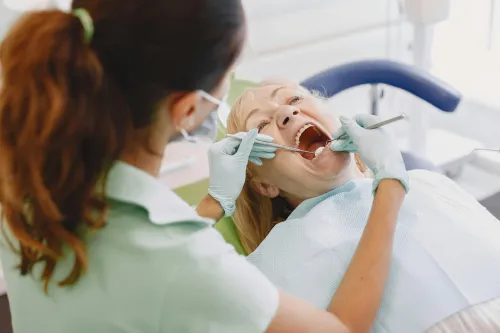
So, what exactly happens at a dental appointment for babies? As you might expect, your child’s pediatric dentist will examine your baby’s teeth. The dentist will look not only for signs of tooth decay, but also for any conditions that may require special care. For instance, if your child has dental enamel defects, you might need to take extra precautions to prevent tooth decay.
For many patients, however, the first visit will end up being primarily an important educational opportunity for the parents. For example, your child’s pediatric dentist will teach you how to properly care for your baby’s teeth and gums. Daily brushing and flossing are essential for preventing cavities, but how are parents supposed to know how to clean a baby’s teeth properly? Of course, you can – and should! – read our articles about how to brush babies’ teeth and how to floss, but there truly is no substitute for in-person guidance. Your child’s pediatric dentist will demonstrate and guide you through the process of cleaning your baby’s teeth so that you can protect your child’s oral health as best as possible.
Your child’s pediatric dentist will also ask about eating habits and provide dietary counseling. Many parents are surprised by some of the ways in which foods and drinks affect their children’s oral health. For example, did you know that the American Academy of Pediatric Dentistry recommends against allowing your child to drink juice from a bottle or sippy cup? Or that many teething biscuits contain sugar and can be harmful for babies’ teeth? Or that eating starchy foods like white bread can lead to cavities? Discussing your child’s eating habits with a pediatric dentist early on is an excellent way to get personalized feedback and tips on how to encourage your child to eat in a tooth-friendly way.
Finally, your baby’s first dental appointment is a wonderful opportunity for you to get answers to all of your oral-health-related questions. Are you having trouble weaning your child from pacifiers? Not sure how to help relieve your child’s teething pains? This is the perfect time to get guidance from a professional!
For Booking Appointment Call Or Visit Website Now